Tuesday, November 20, 2007

HeavenEarth, Ten Chi


(reprinted with permission)

Late in choreographer Pina Bausch's "Ten Chi," Dominique Mercy stands upstage wearing a wine-red kimono. He waits, palms facing outward, his gaze fixed on the middle distance. A man unties Mercy's sash, then slips the red gown off with ceremonial calm. A white kimono is revealed. That robe is peeled away. Below it, Mercy wears a purple gown. That, too, is slipped off and beneath it is revealed a black kimono.

Finally, the black gown is removed. With a small shock, we discover veteran dancer Mercy wrapped in yards of tissue-thin, blood-red fabric. When that, too, is shed, Mercy stands before us, all but naked. Next, he slips into a Western-style shirt and long Western trousers and begins a haunting dance solo.

Vignettes like this, which seem to sum up Japan as a culture that poignantly dresses itself both in its own and a foreign culture's traditions, pack the evening-long dance theater work performed by Bausch's Tanztheater Wuppertal at Berkeley's Zellerbach Hall Friday night.

"Ten Chi," in fact, is an homage to a culturally layered, often magical and sybaritically surreal Japan, created by Germany's high priestess of dance theater with her dancers, who first performed it in 2004. It is among her recent lineup of savvy and unsentimental love letters to whole cultures.

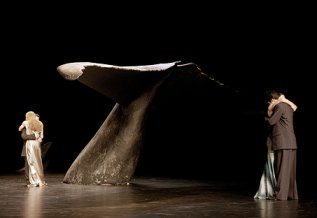
As an island country, Japan lives off the sea, with fish and seaweed as central to the diet as milk is to the French. It makes exquisite sense that the central prop created by long-time Bausch decor wizard Peter Pabst is an outsized whale tail downstage left and, upstage, deep right, a protruding mound of whale torso. The mythic whale's vast form, like reality itself, is visible to us only in part.


As a canny metaphor, the whale fragments get at the sometimes buried, always layered nature of Japan's traditions and also do a pretty good job of summing up the giddy displacement of love, sex and intimacy. These potent forces seem to lurk beneath the dancers' feet, compelling, comic and sometimes monstrous.

Female longing erupts throughout. A character, for example, goes gaga over gorgeous vegetables. Another gets hot over a sizzling black shopping bag. Still another is titillated to the point of hysteria by protruding feet in an otherwise deserted movie theater. Women's fantasies and longing overwhelm moments as much as cleanliness, solitude and anxiety did in "Nur Du," Bausch's 1996 portrait of the United States. It is no wonder that Japan is a country of fans.

A second decor element, falling petals or snowflakes, does for our sense of time what the whale parts do for our grasp of space. From early on, we see a single petal fall. Then, later, another. By intermission, a blizzard of white descends on the unpopulated but still-visible stage space. Bausch lets theatrical time run even as the audience leaves the theater to use the bathroom.

It was not a perfect night. There were fallow scenes, and segues from one evocative music choice to another often lurched ineptly. But Bausch is never after perfection. She builds operatic renderings of life that finger the comic, the grotesque and the beautiful. "Ten Chi" had plenty of it all.

And for the lovers of sheer movement, the wild calligraphic dance solos that stocked the evening were a joy. They were full of the flexed feet of Noh, the lunges of martial arts, the robotic angles of video and the sinewy ripples of geisha dance. They also ranged from the virtuosic work of young dancers to less elastic but theatrically keen solos of the older performers.

It was a blizzard of such solos that brought the night to a stunning close. How apt it seemed that in a landscape so alive with petals/snow, everyone danced alone, yet no one, but no one, looked lonely.

Friday, November 2, 2007

carrolling


reprinted from SF Gate
by Jon Carroll, 2000

ABOUT A DECADE ago I was in the town of Launceton in the state of Tasmania, which is an island off the south coast of Australia. Tasmania is famous for its devils (nocturnal marsupials, relatively gentle unless you are a nocturnal rodent), wombats (herbivorous marsupials with square excrement), landscape (wild rivers, lush mountains, stormy seas) and conservative residents (think Kansas, 1956).

It was night. I was by myself in a car, driving back to the B&B after a meeting. Uncertain of my direction, I pulled to the curb to get out my map. Looking up, I saw on the corner, bathed in the streetlight, a man alone. He was dancing.

There was no music. The street was entirely deserted except for me and him. He was not performing. He was just dancing.
I am the last person to be sentimental about drunkenness -- I am guessing that booze played a profound initiative role in this impromptu display of the terpsichorean arts -- but I was still charmed by the moment. I smiled then, and somehow the shutter of my memory clicked when I smiled, and that image is with me now.

He was wearing a dark pea coat and bulky shoes. He might have been a sailor. Sailors have a grand tradition of male dancing, hornpipes and the like, and he may have been answering an ancient call. It was a stately dance, whatever it was, suffused with regret and dignity.

Perhaps he was making a graceful gesture unto the Lord. Perhaps he was just blotto. Doesn't matter. His dance is mine now, to do with as I will. Viz: MEN -- AT LEAST pale guys like me -- don't dance enough. Somehow between the age of the windjammers and now, dancing became unmanly. Lots of men I know ``don't dance,'' they often announce. There are also women who ``don't dance,'' but they are rarer.

An enduring image from high school: two girls dancing together, for want of partners, for love of dancing anyway. A lot of guys are situational dancers -- they will dance during the courtship phase, then stop as soon as the mate is securely bound by mutual vows.

The idea of dancing as an interior event has been lost. It's either a social thing or a performance thing; it somehow involves awareness of a partner or an audience or both.

At my gym, many people exercise with earphones on. Maybe some of them are listening to NPR or Rush Limbaugh, but some of them are listening to music. I assume that the people attached to CD players are listening to music. I'm listening to music.

And yet they do not dance. They work on their little machines with fierce dedication, not a move wasted, not a gesture inserted merely for the sake of gesture. Is the music being used merely as white noise, to shut out other sounds? Are they all listening to Beethoven string quartets and following the complexity of thematic development? Or . . . what?

Sometimes, on my little reclining bicycle, I dance. I keep my eyes closed because I fear the opprobrium of others. Nevertheless, I am addicted to the rhythm; it's what keeps me coming back.

I recently played the soundtrack album to ``The Sopranos.'' The theme by A3 was on. ``Got myself a gun,'' I sang softly, and did a small interpretive movement involving pointing my fingers and cocking my thumbs. All of a sudden, I wanted to be on a lonely street corner in Tasmania.

Sunday, October 21, 2007

Deja Vu All Over Again


reprinted with permission


It was déjà vu all over again Saturday afternoon at Oakland's Paramount Theatre. Oakland Ballet was back on stage, Ronn Guidi was in charge, and company icons were floated out in a straightforward and unpretentious celebration of what the old Oakland Ballet always did best: sweetly, and imperfectly, dance.

When a dance company slips away, as Oakland Ballet under Karen Brown did last year, the dance disappears, too. There's no material artifact left behind to remind us of what took place. This made it a curious experience Saturday -- at once comforting and discomfiting -- to see some of the same dancers perform some of the same dances they executed on the Paramount stage years ago. More touching and curious still, they managed to recreate the feel and mood of the old Oakland Ballet with its combination of zeal and naivete. Time appeared to stand still.

As a contest to resuscitate a comatose body and restore it to its previous state, Guidi (and his new performing arts foundation) succeeded in spades. But if Saturday's concert was meant as a harbinger of future plans, it is unclear what Oakland Ballet has in mind.

With financial support from Chevron and Target, the concert toured the storehouse of Guidi's Oakland Ballet (1965-1999), from his lighthearted commedia del l'arte homage, "Carnival d'Aix"(1980), to Vaslav Nijinksy's epoch-making "Afternoon of a Faun" (1912) and Mark Wilde's athletic take on Maurice Ravel's iconic "Bolero."

Given the dearth of dancemaking know-how these days, Guidi's skill read across the footlights as honest, if not scintillating, craftsmanship. His "Trois Gymnopedies" set to the Erik Satie music by the same name, was a beautiful, brutally simple study in flow and essential abstract form. "Carnival" was a charming trifle set to an exquisite score of 12 inventive dances by pioneering composer Darius Milhaud.

The limpid "Gymnopedies," dating from 1961, is one of the choreographer's more lasting works, embodying the music's timeless air of a flowing stream. Although the dancers struggled to master and transcend the movements, and couldn't, the simple boldness of the work shined through.

Nijinksy's "Faun" is a still-modern study in archaic mystery, but Saturday's performance slipped toward empty exoticism. Ethan White as Faun, along with the chorus of Nymphs, lacked the full-body articulation essential to the ballet's eerie two-dimensional power. Jenna McClintock as the lead Nymph got much closer to the quality and captured the demure tranquility of her role.

Wilde's "Bolero" is an entertaining and athletic account of dance on a naked stage. It was a great closer and showed the company to full advantage. The entire concert was accompanied heartily by the Oakland East Bay Symphony with Michael Morgan conducting, giving each work the musical support it deserved.

Guidi's company always embraced the audience with small town bonhomie, and Saturday afternoon Oakland Ballet danced with honesty and heart. They resurrected works and resurrected the mood. But the question remains: Is this enough to relaunch Oakland Ballet?

Saturday, October 13, 2007

return of the repressed


today jenn invited me to become her friend on facebook. even though i had been certain 10 minutes earlier that i'd no more join facebook than hang out at my children's parties, i set up an account.


i went through the usual rigamorole of the who what where when of it. i signed up. i was inside facebook.

or was I?

suddenly i found myself faced with a voice right out of elementary school: "you don't have any friends yet" the screen read.

i was floored. what a brilliant ploy. a stroke of primitive genius.

on the one hand this read like the line of an adult to a lonely child, a grownup trying to unravel the causes for the kid's sadness with a biting dose of truth girded by a single word of optimism: "yet". but it was also the cruel and patronizing assertion of the brat to the new kid pretending to tell a simple truth when she's actually flaunting her new social status--she's suddenly "in" because an outsider has penetrated the boundaries of the social group and by her very newness redefined what's known and what's not, what's inside and what's out. "you don't have any friends" invokes everyone's fear of being that friendless oucast. "yet" promises that the group isn't fixed--yesterday's outcast can be tomorrow's insider.

so you're through a door but it's a door of false promise. you're not really in at all but in an eerie transitional space in which not only is the future uncertain but the nature of what's behind you is subverted: you thought you had a social world? you thought you had easy access to the people in your life? you thought you engaged in unfettered communication with the people you care about? HAH. you in fact are in an endless seeming dreamspace defined by closed portals--tens of thousands of them--to which you can gain access only by permission. to not go forward is to crawl back from your transitional state, defeated, condemned to a life outside and friendless. to go forward is to plow into an unformed and therefore forbidding universe. this surreal state and the discomfitting freefall that accompanies it is designed to make people scramble to establish a place in the virtual realm: join facebook and flee the void you've unwittingly entered.

one of the underlying promises is of a new social world parallel to or better than ones social place in the material world. the other is of being rescued from friendlessness.

so, how many friends do you have?

Monday, October 8, 2007

BY DEUCE!


reprinted by permission


Many years ago, during early Sunday morning arts programming on television, a group of young women in jazz shoes occupied a television studio stage. They moved independently, communicating introspectively, their hips swiveling, legs swishing, and spines slipping to the sounds of Bix Beiderbecke.

It was strange and a little disturbing. Who made dances so cool, so sexy and so unexpected? The answer was simple: Twyla Tharp.

This weekend at Zellerbach Hall, the Joffrey Ballet stages one of Tharp's masterpieces, "Deuce Coupe," the opening salvo in Cal Performances' autumn Tharp celebration. In its original form in 1973, "Deuce Coupe" paired the youthful, classically trained Joffrey dancers with Tharp's own ultra-cool company.

The piece was set to a medley of Beach Boys songs -- everything from "Honda" to "Catch a Wave." The combination was incendiary, and a conflagration in the New York dance scene followed.

This time, the 19-part ballet is undertaken by Joffrey Ballet alone. The graffiti backdrop is now a lively, finished artifact (with words like "war" and "peace"), rather than a real-time fabrication as in the original, and the stage is smaller. But the dance is as clear as a bell. Not only is its youthful idealism and silky ingenuity still credible, but "Deuce Coupe" is unobstructed by the turf battles between the two companies that blurred it three decades back. What endures is deceptively effortless genius.

At the epicenter of the work is a figure of a ballerina, performed with chiseled elegance by Heather Aagard, who occupies a pool of silver cool whether she is dancing apart from her pop-colored compatriots or weaving among their luscious, sometimes tongue-in-cheek gyrations. As the songs of youthful yearning and party-going accumulate (don't miss the surreal slo-mo scene), the crowds of dancers come and go, a cross-over takes place: Some of the cool dancers don point shoes and copy the ballerina's steps, and the ballerina loosens her joints.

If you wondered how dance found its way to "Coupe" and where it went after, the Joffrey program tries to answer that, too. Opening the night was the Romantic-era inspiration, "Pas des Déesses" by Robert Joffrey with music by John Field, played live by Paul Lewis on piano. An homage to three great 19th-century ballerinas and their man, it is a showcase for the bravura technique that is at the root of the ballet canon.

Joffrey, who died in 1988, was never a pure classicist, and he was known to flirt with kitsch in his pursuit of elan. "Déesses," in its too broad interpretation of highly restrained and filigreed movement, in its come-hither glances of Valerie Robin and the coy langor of Maia Wilkins, teetered close to sentimentality. Only Jennifer Goodman managed the gestural restraint that defined pure 19th-century ballet form.

"Sometimes It Snows In April" from Laura Dean's 1994 rock ballet "Billboard" (to music by Prince), closed the evening. Moving from linked pairs who touchingly laced the stage space to dancers dancing together alone, culminating in a great pulsing ensemble dance, "Sometimes" ended on a brash but ebullient note: Even when death comes along, the dancing never stops, not even, we suspect, in heaven.

Sunday, September 23, 2007

Denizens of Democracy


reprinted with permission

Imagine tossing together hints of history, visual art and folk culture from the late 1700s. Next imagine cooking this mix down to a broth so refined that you can sense where the various parts came from, though you can no longer see their sources.

Then add dance of layered beauty, wit, and design. Finally, put the whole thing fluidly together with three piano works by Mozart.

The result is Mark Morris' dazzling "Mozart Dances," which had its West Coast premiere Thursday at Cal Performances in Berkeley and runs through Sunday.

Given a commission for an evening-long work to Mozart's music for the Mostly Mozart Festival in New York's Lincoln Center last fall, Morris looked for piano-saturated compositions that he could get his arms around. He chose early, not so early and late Mozart. He then assembled a landscape of movements that returned in new guises throughout the night, everything from simple walks, runs, strident marching, and chasing steps to liquidy falls and circles of seemingly endless variation.

Within this deceptively simple format, Morris takes us on a voyage that coils inward to a jewel-like center and out again. Opening with "Eleven" (Piano Concerto No. 11 in F major), the first section is introduced by men who vanish and leave the stage to black-clad women (costumes by Martin Pakledinaz) in a domain overseen by long-time Morris company member Lauren Grant. Shimmering with authority, the pixielike dancer darts in and out of the action, leading the ensemble like an incarnation of Liberty herself, her dancing a marvel of crystalline timing and fearless intelligence.

Miraculously for an art form bound by time, the center section, "Double" is the place from which everything, ultimately, seems to radiate. Set to the Sonata in D Major for Two Pianos, it is a segment full of mirroring, designed for the men and led by longtime company member Joe Bowie. (Bare-chested and dressed in waistcoat and shorts, he looks like a latter day Lord Nelson.)

Morris fills the scene with allusions to sailoring, friendship and love. Here, British artist Howard Hodgkin's evocative backdrop of outsided brushstrokes is initially lit by warm red tones.

Then, the music shifts, and, with Garrick Ohlsson and Yoko Nozaki on pianos and Jane Glover conducting the Berkeley Symphony Orchestra, so does the climate. Death comes lurking, and when fine-boned Noah Vinson breeches the circling men, sorrows follow. A ghostly crew of women ensues, encircling Vinson, and together they seem joined in an exquisite netherworld.

Morris, not content to leave his actors to their sorrows, allows hope and beauty to wash over the actions. We see it in the delicacy of the gestures, and it emerges in the backdrop in emerald hues -- the green of renewal.

Glory spreads in part three, "Twenty Seven" (Piano Concerto No. 27 in B-flat major). The company is vividly decked in white and set against a modernist red and black version of the backdrop. They form a band of citizens, who parade and shimmer in parallel lines, striding easily, with a liberty of their own. Morris, the humanist, is triumphant.

reprinted with the permission of Contra Costa Times

Saturday, September 15, 2007


Bewegung: Movement, move (of: in motion) is a change of a position and/or a place or a situation, an object or subject sets compared with a reference system.

Thursday, September 13, 2007

Gus Solomons


The extraordinary choreographer, dancer, writer and architect Gus Solomons Jr will be in brief residence at Mills College next month as part of a tour sponsored by the Phi Beta Kappa Society's Visiting Scholar's Program. During his stay he'll offer a public lecture he calls “50 Million Ways to Make a Dance” and will discuss the evolution of his choreography over his 40-year career. The event takes place at Danforth Hall on the campus Thursday, October 4, at 5:15 pm and is free and open to all.

The Boston-raised Solomons took up dance at the Boston Conservatory of Music while at MIT studying architecture, working with Jan Veen in Laban technique and Robert Cohan in Graham. After getting his architecture degree, he moved to New York to dance. He launched his career with Donald McKayle, Pearl Lang, Joyce Trisler and Paul Sansardo then danced with Graham for a season. Soon he pressed on into the kind of late modernist terrain that would come to define his work. He spent from 1964-68 with the Cunningham company, during which time he originated roles in "Winterbranch" and "Rainforest." In 1971 he formed his own troupe, the Solomons Company/Dance, to explore dance as "melted architecture," linking his love of puzzles and design to forms that he has called "kinetic autobiography," according to historian Thomas DeFrantz. In 2000 he was awarded a "Bessie" for sustained achievement in choreography.

On a side note, Phi Beta Kappa is that society for select brainiacs who display excellence across disciplines and open-minded curiosity. It was started at the venerable College of William & Mary in 1776 (16 signers of the Declaration of Independence attended, and George Washington got his surveyors certificate there). The Greek initials Phi Φ(F) Beta (B ) and Kappa (K) - represent the motto "Love of learning is the guide of life" (philosophia biou kubernetes).

On another and architecturally pertinent note, the small case Phi, φ, represents the Golden Mean in math--1.618--drawn from the ratio of 1 plus the square root of 5 over 2 and defines the harmonious division of a line as understood by the ancient Greeks. Many architects live by its elegant proportions.

Sirius Consequences


The dog days of August that scorched New York and ignited fires in the West have passed. I've noticed this last week that the light has begun to look bruised late in the afternoon and the air is starting to chill, like an old woman's hands. Harvest time. The squirrels are eating anything resembling fruit and stashing nuts in flower pots. I can smell the tangy rot of apples. In the yard, the petals of white dinner plate dahlias are mashed on the ground.

Other smells--the scent of sorrow in the body politic mixed with an ugly stink of predation. I've watched public cheating and stealing being tossed off as a kind of game by people who have no need to cheat or steal. Much of the social contract is broken. And beneath that rot I detect an odor of abiding fear. The economy is held aloft by churning debt, and soldiers are returning from an infernal occupation looking more gruesome than anything Mary Shelley imagined for her Monster. We're living in an age of hucksterism bolstered by inquisitorial zeal.


Red or blue, it isn't what most of us signed up for.

This next year things are going to rock and roll. An election is coming. Remember the last two?

The good news, if you believe in signs and portents, is that the Muslim and Jewish new years, Ramadan and Rosh Hashanah, both began yesterday. A new synchronized beginning....I can dream can't I?

L'shanah tovah.


Kullu Sana wa Antum bi-Khayr.


The top of the dance season is also here. This week Jo Kreiter's Flyaway Productions takes on war and propaganda in her latest piece, "Lies You Can Dance To." Next week Mark Morris' deceptively formal Mozart Dances makes its premiere in Berkeley. Morris, whom pianist Emanuel Ax suggested could have been a conductor had he not been a dancer, has crafted a night packed with piano music--a tryptich of 2 concertos and one sonata with three sections each.

Cal Performances then launches into a Twylathon, beginning with the Joffrey Ballet performing Deuce Coupe.


Lines Ballet's 25th anniversary season begins November 2 with the inimitable Zakhir Hussain, the genius of tabla, and Philharmonia Chamber Players.

Music is dance's main squeeze this season; Politics is its shadow.

Sunday, August 5, 2007

Bird on Fire


Tamara Karsavina, Michel Fokine's original Firebird.

photo by Emil Otto Hoppe

Friday, August 3, 2007

Bird Don't Call


Pierre's molting. His singing's stopped. He's entered a month of silence, and he flits but does little flying. I wonder, who's his god?


(Exotic Bird by Jan Sand)

Bird Love


Our Breath Is As Thin As A Hummingbird’s Spine
Nanos Operetta and inkBoat
July 27

In his latest outing, butoh maverick Shinichi Iova-Koga put himself under the powerful spell of Nanos Operetta and its director Ali Tabatabai, along with dramaturge Ellen Sebastian Chang, to create "Our Breath Is As Thin As A Hummingbird's Spine." Performing in July with long-time Bay Area actor Sten Rudstrom, and backed by the adept seven-member music ensemble, Iova-Koga and his collaborators produced a touching if unrealized surrealist cartoon about unrequited love of a man for a bird.


This was a light year from Iova-Koga’s solo winter show, “Milk Traces,” in which he worked alone in a tiny black box theater, presenting spare butoh with a furious intensity that seemed to float in a pool of quiet. It was also a big break from his spellbinding all-white duet in 2004 “Ame to Ame,” where relationships and objects were both acutely abstract and audibly physical. This time the comedic ruled, and narrative became a series of sometimes-delightful gags and absurd juxtapositions that, although offbeat, were unable to establish the kind of poetic depth that has distinguished Iova-Koga’s work in the past. Whether due to divergent methods and aesthetics among the team, or too little time, the result was a production that seemed still in workshop phase, ripe for a huge shove into far more illogical and less comic book terrain.

With the versatile and imaginative band backed against the theater’s brick wall and made spectral by a scrim, the concert began with salted whiskey baritone Nyls Frykdahl (of Sleepytime Gorrila Museum renown) in faintly Dickensian rust colored morning coat and top hat, crooning into his mike a rococo tale of unexpected love. Next, Iova-Koga took charge of the proceedings as he emerged from a squinchy fairytale door (marked “door”). He was dressed in a pulsing red lounge suit and shirt bedecked in gold glitter. The Lounge Lizard get-up was apt costume for a man about to fall in love with a skinny, cool-hearted and red-legged bird. Less than 10 feet away, out of a huge nest (labeled “nest”) on a platform, a ball of lemon-yellow feathers emerged until it revealed itself to be as big as Big Bird but even stranger looking, like a giant feathery yellow fruit on top of two ridiculously thin red sticks.

It’s at this point that I should disclose that I was given a canary songster as a gift quite recently, and as I watched “hummingbird”, I experienced an eerie sense that the production was channeling my life with my new friend. Since I hadn’t read the program beforehand, I was abashed to see myself in the story. Critics shouldn’t do that. But during intermission I read the notes: Operetta’s Tabatabai, like me, had tripped into a deep love for his pet, a sentient ball of feathers in a cage. Soon enough he found that no matter how loving or entertaining he was, his depth of feelings weren’t met in the slightest, a role Iova-Koga played with exquisite tenderness and comedy, whether it was performing a liquidy dance of yearning, a series of entertainments with a branch (golfer, batter, dog, paddler), a goofy chicken dance, or lip sync-ing “You Are my Destiny” (Paul Anka). But there’s another story to bird love. Avian sentience is strange and delicate and to find any communion one may have to enter bird mind. What a ripe path for butoh to travel.


But that’s not where “Hummingbird” ventured. Well into the production, Rudstrom cut then devoured the string that tied together the tin can phones that were meant to connect the two creatures across their animal and existential divide. It then became even clearer that if the bird—or any solipsist, for that matter––could talk intelligibly about its state, it would probably echo Tina Turner and ask: “What’s love got to do with it?” This made crystalline that interspecies love was really the pretext, not the point of this cracked fairy tale about love. What was this “pet,” after all, but a blazing narcissist in feathers happier to preen in his bed before a mirror than commune with a companion, which sounds like plenty of people plenty of us know. The team never quite sorted these facts.


One of the moments when Iova-Koga came close to taking the story into more layered terrain is when he accepted a beribboned box and out of an egg-shaped package he made materialize a female blow-up doll with B-29 breasts. Then he taped feathers on her arms. But committed too literally to the bird tale, “Hummingbird” lost its drift. And as welcomed as his voice was, it was unclear why the captivating Frykdahl kept popping up when he did, darkly singing hurdy-gurdy songs (“Lulu, for us the moon is too high. A spoon on the table is a star in the sky.”). Such episodes neither deepened the mystery nor injected a big enough dose of helium into the atmosphere.

But even with its flaws, “Hummingbird” was valiant and madcap. And it reminded us that butoh is a large Dadaist container capable of holding all kinds of material dredged up from the wild recesses of our hearts, our homes and our cages.

Thursday, July 12, 2007

in memory of carol, who died last night


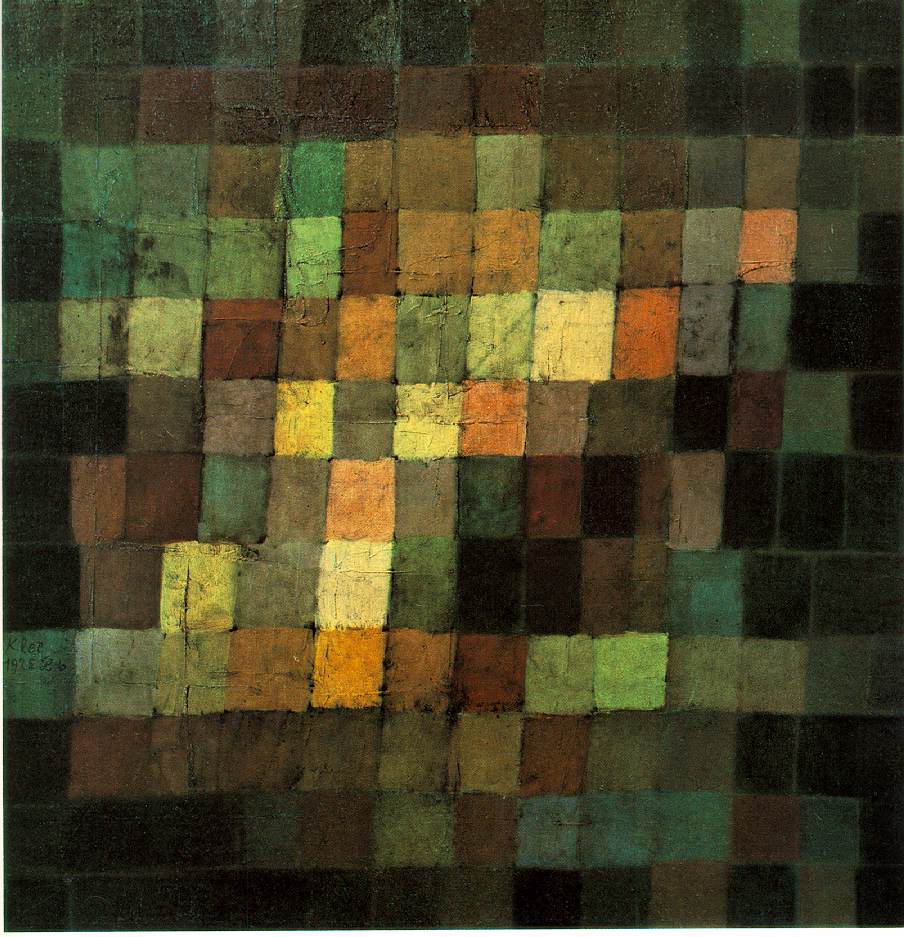
paul klee's Ancient Sound


Yit-gadal v'yit-kadash sh'may raba b'alma dee-v'ra che-ru-tay, ve'yam-lich mal-chutay b'chai-yay-chon uv'yo-may-chon uv-cha-yay d'chol beit Yisrael, ba-agala u'vitze-man ka-riv, ve'imru amen.
Y'hay sh'may raba me'varach le-alam uleh-almay alma-ya.

Yit-barach v'yish-tabach, v'yit-pa-ar v'yit-romam v'yit-nasay, v'yit-hadar v'yit-aleh v'yit-halal sh'may d'koo-d'shah, b'rich hoo. layla (ool-ayla)* meen kol beer-chata v'she-rata, toosh-b'chata v'nay-ch'mata, da-a meran b'alma, ve'imru amen.

Y'hay sh'lama raba meen sh'maya v'cha-yim aleynu v'al kol Yisrael, ve'imru amen.

O'seh shalom beem-romav, hoo ya'ah-seh shalom aleynu v'al kol Yisrael, ve'imru amen.

Tuesday, July 10, 2007

Albert Einstein & Rabindamath Tagore Talk


Excerpted from: A Tagore Reader, edied by Amiya Chakravarty

Tagore and Einstein met through a common friend, Dr. Mendel. Tagore visited Einstein at his residence at Kaputh in the suburbs of Berlin on July 14, 1930, and Einstein returned the call and visited Tagore at the Mendel home. Both conversations were recorded and the above photograph was taken. The July 14 conversation is reproduced here, and was originally published in The Religion of Man (George, Allen & Unwin, Ltd., London), Appendix II, pp. 222-225.

TAGORE: I was discussing with Dr. Mendel today the new mathematical discoveries which tell us that in the realm of infinitesimal atoms chance has its play; the drama of existence is not absolutely predestined in character.

EINSTEIN: The facts that make science tend toward this view do not say good-bye to causality.

TAGORE: Maybe not, yet it appears that the idea of causality is not in the elements, but that some other force builds up with them an organized universe.

EINSTEIN: One tries to understand in the higher plane how the order is. The order is there, where the big elements combine and guide existence, but in the minute elements this order is not perceptible.

TAGORE: Thus duality is in the depths of existence, the contradiction of free impulse and the directive will which works upon it and evolves an orderly scheme of things.

EINSTEIN: Modern physics would not say they are contradictory. Clouds look as one from a distance, but if you see them nearby, they show themselves as disorderly drops of water.

TAGORE: I find a parallel in human psychology. Our passions and desires are unruly, but our character subdues these elements into a harmonious whole. Does something similar to this happen in the physical world? Are the elements rebellious, dynamic with individual impulse? And is there a principle in the physical world which dominates them and puts them into an orderly organization?

EINSTEIN: Even the elements are not without statistical order; elements of radium will always maintain their specific order, now and ever onward, just as they have done all along. There is, then, a statistical order in the elements.

TAGORE: Otherwise, the drama of existence would be too desultory. It is the constant harmony of chance and determination which makes it eternally new and living.

EINSTEIN: I believe that whatever we do or live for has its causality; it is good, however, that we cannot see through to it.

TAGORE: There is in human affairs an element of elasticity also, some freedom within a small range which is for the expression of our personality. It is like the musical system in India, which is not so rigidly fixed as western music. Our composers give a certain definite outline, a system of melody and rhythmic arrangement, and within a certain limit the player can improvise upon it. He must be one with the law of that particular melody, and then he can give spontaneous expression to his musical feeling within the prescribed regulation. We praise the composer for his genius in creating a foundation along with a superstructure of melodies, but we expect from the player his own skill in the creation of variations of melodic flourish and ornamentation. In creation we follow the central law of existence, but if we do not cut ourselves adrift from it, we can have sufficient freedom within the limits of our personality for the fullest self-expression.

EINSTEIN: That is possible only when there is a strong artistic tradition in music to guide the people's mind. In Europe, music has come too far away from popular art and popular feeling and has become something like a secret art with conventions and traditions of its own.

TAGORE: You have to be absolutely obedient to this too complicated music. In India, the measure of a singer's freedom is in his own creative personality. He can sing the composer's song as his own, if he has the power creatively to assert himself in his interpretation of the general law of the melody which he is given to interpret.

EINSTEIN: It requires a very high standard of art to realize fully the great idea in the original music, so that one can make variations upon it. In our country, the variations are often prescribed.

TAGORE: If in our conduct we can follow the law of goodness, we can have real liberty of self-expression. The principle of conduct is there, but the character which makes it true and individual is our own creation. In our music there is a duality of freedom and prescribed order.

EINSTEIN: Are the words of a song also free? I mean to say, is the singer at liberty to add his own words to the song which he is singing?

TAGORE: Yes. In Bengal we have a kind of song-kirtan, we call it-which gives freedom to the singer to introduce parenthetical comments, phrases not in the original song. This occasions great enthusiasm, since the audience is constantly thrilled by some beautiful, spontaneous sentiment added by the singer.

EINSTEIN: Is the metrical form quite severe?

TAGORE: Yes, quite. You cannot exceed the limits of versification; the singer in all his variations must keep the rhythm and the time, which is fixed. In European music you have a comparative liberty with time, but not with melody.

EINSTEIN: Can the Indian music be sung without words? Can one understand a song without words?

TAGORE: Yes, we have songs with unmeaning words, sounds which just help to act as carriers of the notes. In North India, music is an independent art, not the interpretation of words and thoughts, as in Bengal. The music is very intricate and subtle and is a complete world of melody by itself.

EINSTEIN: Is it not polyphonic?

TAGORE: Instruments are used, not for harmony, but for keeping time and adding to the volume and depth. Has melody suffered in your music by the imposition of harmony?

EINSTEIN: Sometimes it does suffer very much. Sometimes the harmony swallows up the melody altogether.

TAGORE: Melody and harmony are like lines and colors in pictures. A simple linear picture may be completely beautiful; the introduction of color may make it vague and insignificant. Yet color may, by combination with lines, create great pictures, so long as it does not smother and destroy their value.

EINSTEIN: It is a beautiful comparison; line is also much older than color. It seems that your melody is much richer in structure than ours. Japanese music also seems to be so.

TAGORE: It is difficult to analyze the effect of eastern and western music on our minds. I am deeply moved by the western music; I feel that it is great, that it is vast in its structure and grand in its composition. Our own music touches me more deeply by its fundamental lyrical appeal. European music is epic in character; it has a broad background and is Gothic in its structure.

EINSTEIN: This is a question we Europeans cannot properly answer, we are so used to our own music. We want to know whether our own music is a conventional or a fundamental human feeling, whether to feel consonance and dissonance is natural, or a convention which we accept.

TAGORE: Somehow the piano confounds me. The violin pleases me much more.

EINSTEIN: It would be interesting to study the effects of European music on an Indian who had never heard it when he was young.

TAGORE: Once I asked an English musician to analyze for me some classical music, and explain to me what elements make for the beauty of the piece.

EINSTEIN: The difficulty is that the really good music, whether of the East or of the West, cannot be analyzed.

TAGORE: Yes, and what deeply affects the hearer is beyond himself.

EINSTEIN: The same uncertainty will always be there about everything fundamental in our experience, in our reaction to art, whether in Europe or in Asia. Even the red flower I see before me on your table may not be the same to you and me.

TAGORE: And yet there is always going on the process of reconciliation between them, the individual taste conforming to the universal standard.

Thursday, July 5, 2007

The Dying Swan


by Alfred Lord Tennyson

I.
The plain was grassy, wild and bare,
Wide, wild, and open to the air,
Which had built up everywhere
An under-roof of doleful gray.
With an inner voice the river ran,
Adown it floated a dying swan,
And loudly did lament.
It was the middle of the day.
Ever the weary wind went on,
And took the reed-tops as it went.


II.
Some blue peaks in the distance rose,
And white against the cold-white sky,
Shone out their crowning snows.
One willow over the river wept,
And shook the wave as the wind did sigh;
Above in the wind was the swallow,
Chasing itself at its own wild will,
And far thro’ the marish green and still
The tangled water-courses slept,
Shot over with purple, and green, and yellow.


III.
The wild swan’s death-hymn took the soul
Of that waste place with joy
Hidden in sorrow: at first to the ear
The warble was low, and full and clear;
And floating about the under-sky,
Prevailing in weakness, the coronach stole
Sometimes afar, and sometimes anear;
But anon her awful jubilant voice,
With a music strange and manifold,
Flow’d forth on a carol free and bold;
As when a mighty people rejoice
With shawms, and with cymbals, and harps of gold,
And the tumult of their acclaim is roll’d
Thro’ the open gates of the city afar,
To the shepherd who watcheth the evening star.
And the creeping mosses and clambering weeds,
And the willow-branches hoar and dank,
And the wavy swell of the soughing reeds,
And the wave-worn horns of the echoing bank,
And the silvery marish-flowers that throng
The desolate creeks and pools among,
Were flooded over with eddying song.

Swan's Way


Mi-Xa-Cka, Chief White Swan


Swan's Nebula

Swan Lake, Montana

bluebird, bluebird


Alicia Markova as Bluebird. Photo by Carl Van Vechten. October 6, 1940.

Tuesday, July 3, 2007

from "The Truth About God" by Anne Carson


God's Work

Moonlight in the kitchen is a sign of God.
The kind of sadness that is a black suction pipe extracting you
from your own navel and which the Buddhists call

"no mindcover" is a sign of God.
The blind alleys that run alongside human conversation
like lashes are a sign of God.

God's own calmness is a sign of God.
The surprisingly cold smell of potatoes or money.
Solid pieces of silence.

From these diverse signs you can see how much work remains to do.
Put away your sadness, it is a mantle of work.

Lone Ranger Religion


Disguised as a book review, this witty discourse on Lone Ranger Religions by my professor friend in NYC discusses issues of spiritual authority among the Big Three versus the polytheists. Harry (writing under an alias here) is a leader in the drug decriminalization movement and one of the sweetest iconoclasts I know. Although only half Irish, he can soberly drink any of you under the table and regale you with stories until your eyes close and the drool is leaking out of your mouth. He is currently doing research on the relation between national marijuana arrest rates and race. Makes San Francisco look pretty damn good. Watch out New Yorkers; beware Minneapolis.


ENOUGH WITH THE 'ONE GOD' STUFF


By James Foley, AlterNet. Posted September 23, 2006.

Sam Harris's book "The End of Faith: Religion, Terror, and the Future of Reason," which won the 2005 Pen Award for nonfiction, develops a smart, knowledgeable polemic about the growing dangers of all religious ideologies. Although I love Harris' rant, my personal obsession has long been with how weird monotheism is. Monotheism insists there is but one god, a man of course, alone in the universe for all eternity. Even as a child, I found this to be a crazy idea.

The Greeks and Romans, the Hindus, and the Egyptians all imagined many different gods who hang out together, the way people throughout the world do. These cultures envisioned social gods with busy existences who like pleasure, food, sex, art and other good things of life. As with people, the social ties among the gods loosely constrain their destructive impulses. Mostly these gods are so involved with each other they only sometimes notice the lesser beings, just as people only sometimes notice their household animals. The multiple gods of great cultural systems, and the gods and spirits of many tribal cultures as well, are familiar, understandable. They project the human world into the sky, the same way science fiction does (except, of course, science fiction understands it is offering fiction).

But monotheism posits one omnipotent, lonely sucker all by himself -- "the sky god" as Gore Vidal once called him. The first five books of the Hebrews' Bible reveal, not surprisingly, that the sky god is often angry, jealous, vengeful, and even murderous -- regularly toying with, manipulating and punishing the puny beings he creates to worship and amuse him. Not surprisingly, he's a self-absorbed ascetic who invents for his "children" bizarre, impossible-to-comply-with rules governing a multitude of tiny details of daily life. Sometimes he goes berserk about minor infractions; frequently he ignores major violations of his own rules. He's the original bad father, threatening awful punishments, with no wife, lover, siblings, friends, co-workers, neighbors or relatives to reign him in.

Early Christians and then Muslims added to monotheism the great creative innovation of the promise of eternal life. A person gets to live forever if, and only if, that person closely follows the sky god's rules. This made monotheism much easier to sell, especially when coupled with the offer of extra credit toward salvation for converting others. It also made monotheism fantastically effective in motivating, inspiring, controlling and ruling people. Fueled by the monotheists' inexhaustible missionary zeal, in nearly 2,000 years this peculiar ideology has spread throughout much of the globe.

Here in the high-tech futuristic 21st century, the punitive, vengeful, sky god is as strong and legitimate as he's been in a long time. Modernity, it turns out, was no cure for monotheism. If anything, it increases extremism, especially -- but never only -- among the dispossessed. And now in the Middle East we have the volatile blend of pissed-off Jews, Muslims, and Christians, each convinced they possess an a iron-clad mandate from their one and only angry god. Mixed in as well are many weapons, lots of oil, and the dangerous, born-again idiocy of George W. Bush and other prominent Republicans. All this is concentrated on the turf that monotheists everywhere see as their origin, their home, their "holy land."

Present-day America's most popular form of lunatic monotheism -- fundamentalist, evangelical Protestantism (and especially end-of-days Christianity with tens of millions of believers convinced that Jesus is returning soon) -- is deeply obsessed with the holy land. Crazed Christian fundamentalists love it when crazed Jewish warriors battle it out with crazed Islamic warriors. The Pat Robertsons regard the wars as win-win and ordinary believers see them as signs that the saved will soon be lifted to heaven. Unfortunately, these fundamentalist Christians now have enormous influence over the foreign policy of the most powerful nation in the world.

Most monotheists want governments to punish people who fail to obey some of the sky god's ascetic rules. Even moderate, middle-of-the-road monotheists -- like the Roman Catholic Church -- pressure governments to criminalize and punish homosexuality, drug use and abortion. The large and growing numbers of Christian, Muslim and Jewish fundamentalists have far grander ambitions.

Inevitably, some prominent believers turn out to have long been hypocrites, liars and secret sinners -- adulterers, gamblers, drug users, homosexuals. But hypocrisy poses no threat to the monotheists who say the hidden sins demonstrate the awful power of the evils they battle. The self-righteous condemn the sins, of course, but they actually approve of the lies, insisting that "hypocrisy is the tribute that vice pays to virtue -- to the one heavenly lord.

Monotheists, especially in scary and desperate times like our own, easily hate other monotheisms and often loath variants of their own brand. And while they have often been happy to butcher polytheists by the wagonload, monotheists do not ordinarily hate polytheists (except when armed and dangerous). Traditionally, monotheists have regarded pagans as primitive or backward peoples who just don't know any better. But they, the other monotheists and the apostates, do know better, or should.

The historic battles within monotheism are legendary: Hebrews vs. Christians, Sunnis vs. Shiites, Catholics vs. Protestants, Lutherans vs. Calvinists, Church of England vs. dissenters, Puritans vs. Baptists, and so many others. Currently some Islamic extremists have a hard time deciding who they despise more: Is it the evil Christian and Jewish heretics, or is it the evil Muslims heretics? So much heresy, so little time.

For monotheism, it always comes down to heresy, to the rejection of orthodoxy. Starting perhaps with Zoroastrianism, each monotheism itself began as a heresy, instantly generating its own orthodoxy. Heresy -- free thought and choosing to reject the rules -- is the primal offense against the monotheists' conception, and love, of their solitary deity.

The chief authoritarian ideologies of the 20th century were secular and even anti-religious. They are not gone, but they are exhausted. Now, in our global warming, nuclear bomb-loaded world, especially in the United States and the Middle East, we face an older, far more popular and durable ideology: the angry god as mandate and role model.

Like Mark Twain, Bertrand Russell and others before him, Sam Harris insists that the basic premises and literal texts of monotheism are so authoritarian and repressive that people who believe them also easily and frequently support all sorts of other repressive causes. For evidence, see the last 2,000 years of history, or tomorrow's newspaper.